

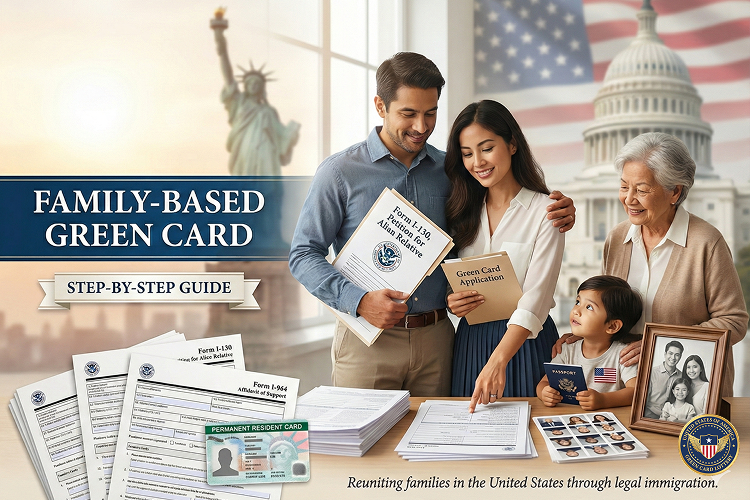
Family reunification is the heart of U.S. immigration policy. Every year, hundreds of thousands of immigrants obtain lawful permanent residency through the Family-Based Green Card Application process. Whether you are a U.S. citizen petitioning for your spouse or a Green Card holder sponsoring your children, family immigration offers a clear path toward living together in the United States permanently.
However, family-based immigration involves strict documentation, multiple approvals, medical exams, background checks, and interviews. Even minor errors can lead to delays or denials. This is why many Diversity Visa applicants prefer expert services like the US Green Card Office, which helps applicants avoid the mistakes that people often make in the Green Card Application process.
This guide covers everything you need to know about eligibility, sponsorship, timelines, costs, documents, interviews, and everyday challenges.

1. Family-Based Green Cards: How the System Works
The U.S. immigration system divides family-based immigration into two main categories:
1.1 Immediate Relatives of U.S. Citizens (No Annual Limits)
This is the fastest and most flexible category. Visas are always available.
Eligible individuals include:
✔ Spouses of U.S. citizens
✔ Unmarried children under 21
✔ Parents of U.S. citizens (petitioner must be 21+)
✔ Certain adopted children
Processing time: 10–18 months in most cases.
1.2 Family Preference Categories (Annual Visa Limits Apply)
These categories face long wait times due to yearly caps.
F1: Unmarried Adult Children (21+) of U.S. Citizens
Wait: 7–10+ years depending on country.
F2A: Spouses & Minor Children of Green Card Holders
Wait: 2–4 years.
F2B: Unmarried Adult Children (21+) of Green Card Holders
Wait: 6–15 years.
F3: Married Children of U.S. Citizens
Wait: 12–20+ years.
F4: Siblings of U.S. Citizens
Wait: 15–25+ years depending on demand.
These long waits underscore the importance of avoiding errors that can restart the entire queue.
2. Who Can Sponsor a Family Member?
To file a Green Card Application, the sponsor must:
✔ Be a U.S. citizen or Green Card holder
✔ Be at least 18 years old
✔ Have a U.S. domicile (primary residence in the U.S.)
✔ Meet income requirements to support the immigrant financially
If the sponsor does not meet the required income level, a joint sponsor may be used.
3. Required Forms for Family-Based Green Card Application
Here are the primary forms you will encounter:
Form I-130
A Petition for Alien Relative proves the family relationship.
Form I-864
An Affidavit of Support ensures the applicant will not become a public charge.
Form I-485 (if applying inside the U.S.)
Adjustment of Status application.
DS-260 (if applying outside the U.S.)
Online Visa Application for consular processing.
Form I-693
Medical examination results.
Biometrics Appointment
Fingerprint & background check appointment.
Each form must be filled out with precision. Minor errors, such as mismatched dates, are significant causes of delays.
4. Documents Required from Both Sponsor & Applicant
A complete Green Card Application must include:
4.1 Documents from the Sponsor
✔ U.S. passport or Green Card copy
✔ Birth certificate or naturalization certificate
✔ Marriage certificate (if applicable)
✔ Proof of termination of previous marriages
✔ Tax returns (usually last 3 years)
✔ Pay stubs/employment letter
✔ Form I-864 (Affidavit of Support)
4.2 Documents from the Applicant
✔ Birth certificate
✔ Passport (valid for at least 6 months)
✔ Police certificates (depending on country)
✔ Marriage or divorce documents
✔ Medical examination results
✔ Two passport-style photos
✔ DS-260 or I-485 form
✔ Proof of legal entry (if adjusting status in the U.S.)
5. How the Family-Based Green Card Process Works
The Green Card Application follows these steps:
Step 1: Petition Filing (Form I-130)
The sponsor submits Form I-130 along with evidence of a genuine family relationship. Processing takes 3–15 months, depending on the category.
Step 2: USCIS Approval & Case Transfer to NVC
Once approved, the case is forwarded to the National Visa Center (NVC), where the documents are collected, and the fees are paid.
Step 3: Consular Processing or Adjustment of Status
If the applicant is outside the U.S.:
They will attend an immigrant visa interview at a U.S. embassy or consulate.
If the applicant is inside the U.S.:
They can file Form I-485 to adjust status and may receive:
✔ Work Permit (EAD)
✔ Advance Parole (travel permit)
Step 4: Medical Exam
A USCIS-approved civil surgeon must perform the medical exam. Missing vaccines or incomplete results can delay or deny the Green Card Application.
Step 5: Green Card Interview
The final step involves a detailed interview:
- For spouses: relationship questions
- For parents and children: documentation verification
- For siblings: identity and background questions
Interview success depends on preparation, honesty, and complete documentation.
Step 6: Approval & Green Card Issuance
If approved, the applicant receives an immigrant visa or an actual Green Card shortly after entry.
6. Common Mistakes That Delay or Deny Family-Based Applications
The most common errors include:
❌ Missing documents
❌ Incomplete I-864 financial proof
❌ Incorrect dates in forms
❌ Marriage not properly documented
❌ Missing joint sponsor (when needed)
❌ Late or missed interview appointments
❌ Untranslated documents
❌ Medical exam issues
These are preventable with careful preparation. Although the US Green Card Office only handles DV Lottery applications, many people use professional immigration services to avoid such pitfalls.
7. How Long Does a Family-Based Green Card Application Take?
Processing times vary:
| Category | Estimated Processing Time |
| Immediate relatives | 10–18 months |
| Spouses of Green Card holders | 1.5–3 years |
| Children of U.S. citizens | 1–3 years |
| Family preference (F1–F4) | 7–25+ years |
Backlogs can lengthen timelines, especially for applicants from Mexico, India, China, and the Philippines.
8. Costs of Family-Based Green Card Application (2026–2027)
Approximate costs:
- Form I-130 filing fee: $675
- Form I-485 filing fee: $1,440 (with biometrics)
- DS-260 fee: $345
- Medical exam: $200–$500
- Affidavit of Support fee: $120 (NVC)
- USCIS Immigrant fee: $220
These may vary slightly by location.
9. Tips to Strengthen Your Family-Based Application
✔ Submit clear, consistent documentation
✔ Prepare relationship evidence for marriage cases
✔ Follow all deadlines strictly
✔ Keep copies of everything submitted
✔ Prepare thoroughly for the interview
✔ Monitor case status regularly