

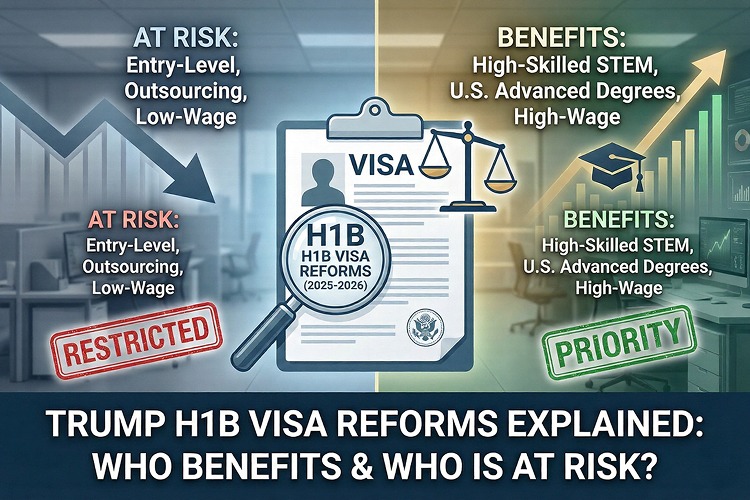
The 2025–2026 Trump H1B Visa reforms have become one of the most discussed topics in global migration, especially for professionals seeking opportunities in the United States. These reforms mark a return to Trump-era prioritiesfavoring high-skilled, high-wage foreign workers while tightening restrictions on outsourcing companies, entry-level jobs, and workers in low-wage industries.
While some applicants stand to gain from the reforms, others may find the pathway to an H1B significantly more challenging. Employers too must adjust to new compliance obligations, documentation demands, and wage-level requirements.
This comprehensive analysis explains who benefits, who faces risks, and how the global labor market may reshape as the updated Trump H1B Visa rules take effect.

1. Overview of the New Trump H1B Visa Reforms
The Trump-style immigration approach focuses on merit, wage level, and national interest, with the aim of bringing “the world’s most skilled talent” into the United States.
Key pillars of the reforms include:
- Higher minimum wage requirements
- Prioritization of high-skilled specialists
- Greater scrutiny of outsourcing and consultancy firms
- A restructured selection system based on merit rather than pure lottery
- Reduced approvals for Level 1 and Level 2 wage jobs
- Strong preference for U.S. master’s and PhD holders
- Stricter rules for third-party job placements
These reforms significantly change who qualifies, who is excluded, and how the H1B system functions.
2. Who Benefits Under the Trump H1B Visa Reforms?
Not all applicants are impacted equally. The reforms are designed to reward individuals with advanced qualifications and high earning potential.
2.1 STEM Professionals The Biggest Winners
Applicants in fields such as:
- Artificial Intelligence
- Robotics
- Cybersecurity
- Software Architecture
- Data Science
- Aerospace Engineering
- Semiconductors
- Biotechnology
are expected to benefit significantly.
Why?
Because the reforms prioritize positions that:
- offer high wages
- require advanced degrees
- contribute to U.S. national competitiveness
- have critical labor shortages
Highly skilled STEM workersespecially those hired directly by large tech companieswill be at the front of the line.
2.2 U.S.-Educated Master’s & PhD Graduates
One of the strongest advantages goes to individuals who earned:
- U.S. Master’s degrees
- U.S. Doctorates
- Advanced research credentials
These applicants traditionally get preference in the H1B lottery through the master’s cap, and under Trump reforms they gain even more priority.
2.3 High-Wage Employees (Level 3 & Level 4)
The wage-based ranking system heavily favors workers whose salary offers fall within:
- Level 3 wage category
- Level 4 wage category
Higher wages signal that the job requires higher skill, which aligns with Trump-era priorities.
2.4 Direct Hires by Major U.S. Companies
Large employers benefit from:
- stronger documentation
- stable work models
- long-term employment plans
Companies like Google, Amazon, Tesla, Intel, and biotech companies are expected to continue receiving approvals for top-tier talent.
2.5 Healthcare Workers in Critical Shortage Fields
The U.S. healthcare shortage remains severe in many regions.
Beneficiaries include:
- nurses
- respiratory therapists
- medical technologists
- clinical lab specialists
While most nurses enter through other visa categories, some advanced healthcare roles may qualify for H1B sponsorship.
3. Who Is at Risk Under the Trump H1B Visa Reforms?
While some workers benefit, many others face significant disadvantages under the new rules.
3.1 Entry-Level STEM Workers (Level 1 Wage)
Junior programmers, recent graduates with no U.S. experience, and applicants at Level 1 wage offers face:
- higher denials
- more RFEs
- reduced selection chances
The Trump H1B Visa structure is intentionally designed to prevent companies from hiring low-cost foreign labor for entry-level positions.
3.2 Outsourcing & Consulting Firm Employees
Workers employed by:
- IT consulting companies
- staffing agencies
- outsourcing firms
are among those most affected.
Why?
Trump-era rules require:
- direct employer-employee relationships
- end-client contracts with detailed duties
- reduced third-party worksite approvals
This has historically resulted in high denial rates for outsourcing-based applicants.
3.3 Workers in Low-Wage Occupations
Some occupations traditionally receiving H1B approvals will now struggle, such as:
- marketing analysts
- administrative professionals
- graphic designers
- business analysts at Level 1 wages
The new framework prioritizes “national interest” roles.
3.4 Applicants Without Advanced Degrees
Workers with only a bachelor’s degree and no specialized technical background may find themselves at a disadvantage.
3.5 Workers From High-Demand Countries With High Competition
Countries deeply dependent on the H1B pipeline will feel the pressure, especially:
- India
- China
- Pakistan
- Bangladesh
- Nepal
High demand + stricter rules = more competition.
4. Impact on U.S. Employers
The Trump H1B Visa reforms also reshape employer expectations.
Employers must now:
- Justify the need for a foreign worker
- Pay higher minimum salaries
- Provide extensive documentation
- Prove that the role is truly specialized
- Show long-term employment need
Small and mid-size businesses may struggle to meet wage requirements, while large corporations will absorb the changes more easily.
5. Alternatives for Workers Affected by the Reforms
If the H1B becomes difficult to obtain, applicants can explore:
- O-1 Visa (extraordinary ability)
- L-1 Visa (intra-company transfers)
- EB-2 NIW (National Interest Waiver)
- Family-based immigration
- Diversity Visa Lottery
Many applicants now turn to the US Green Card Office to professionally file their Green Card Lottery applications because the service helps avoid rejection due to photo errors or incomplete entries.
The Diversity Visa remains one of the easiest, most affordable pathways into the U.S.especially for applicants blocked by H1B restrictions.
6. Should Skilled Workers Still Consider the H1B Route?
Yes but with preparation.
Workers should:
- strengthen technical expertise
- pursue advanced degrees
- negotiate higher wages
- avoid relying on outsourcing firms
- consider backup immigration options
Even with reforms, the H1B remains one of the most valuable visas for skilled foreign talent but only for those who qualify under the stricter standards.