

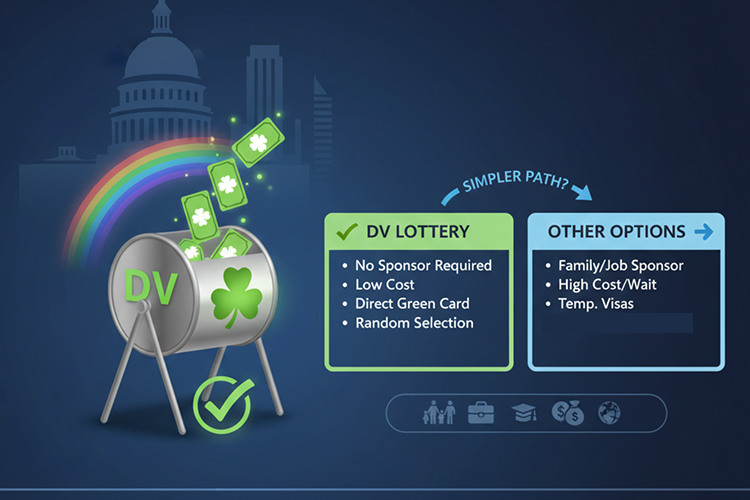
The DV Lottery is often described as one of the simplest ways to obtain a U.S. Green Card, but it is not the only immigration pathway available. Many applicants wonder how the DV Lottery compares with other U.S. immigration options, such as family sponsorship, employment visas, investment-based visas, or temporary nonimmigrant visas.
This guide provides a clear, side-by-side comparison of the DV Lottery and other major U.S. immigration routes, helping you understand the advantages, limitations, and suitability of each option based on your personal situation.
What Is the DV Lottery? (Quick Overview)
The DV Lottery, officially known as the Diversity Visa Lottery, is a U.S. government program that grants up to 55,000 Green Cards each year to individuals from countries with historically low immigration rates to the United States.
Key features of the DV Lottery:
- No employer or family sponsor required
- Random selection
- Low entry barrier compared to other visa categories
- Leads directly to permanent residency
The DV Lottery is unique because it offers direct access to a Green Card, unlike most other visa types that start as temporary status.
Major U.S. Immigration Options Explained
To understand how the DV Lottery compares, it’s important to know the main immigration pathways available.
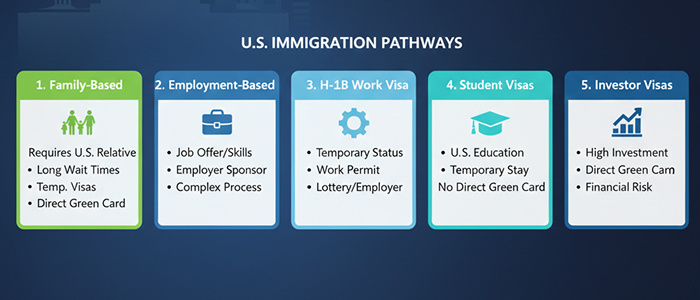
1. Family-Based Immigration
Family-based visas allow U.S. citizens and permanent residents to sponsor relatives.
Pros
- Strong legal pathway
- Direct route to a Green Card
- High approval rate for immediate relatives
Cons
- Long waiting periods (often 5–20 years)
- Requires a qualifying U.S. family member
- Annual visa caps create backlogs.
Compared to the DV Lottery:
The DV Lottery does not require family connections and can be significantly faster if selected.

2. Employment-Based Immigration (EB Visas)
Employment-based visas are issued to skilled workers, professionals, and investors.
Pros
- Clear pathway for highly skilled individuals
- Employer sponsorship adds stability.
- Some categories lead to fast-track Green Cards.
Cons
- Requires job offers or extraordinary qualifications
- Employer dependency
- Long processing times for many countries
Compared to the DV Lottery:
The DV Lottery is more accessible because it does not require a job offer, a degree beyond high school, or employer sponsorship.
3. H-1B Work Visa
The H-1B is a popular temporary work visa for speciality occupations.
Pros
- Allows legal work in the U.S.
- Dual intent (can lead to a Green Card)
Cons
- Highly competitive lottery system
- Employer-controlled
- Temporary status with renewal limits
Compared to the DV Lottery:
The DV Lottery offers permanent residency directly, while H-1B holders may never receive a Green Card.
4. Student Visas (F-1, M-1)
Student visas allow foreign nationals to study in the U.S.
Pros
- Access to U.S. education
- Optional practical training (OPT)
Cons
- No direct Green Card path
- Strict work limitations
- Must leave the U.S. after studies unless status changes
Compared to the DV Lottery:
The DV Lottery provides long-term residency, while student visas are temporary and restrictive.
5. Investor Visas (EB-5)
EB-5 visas are for individuals investing large sums into the U.S. economy.
Pros
- Direct Green Card path
- No employer dependency
Cons
- Very high financial requirement
- Investment risk
- Long processing times
Compared to the DV Lottery:
The DV Lottery requires no investment, making it accessible to ordinary applicants.
6. Refugee and Asylum Status
Asylum is granted to individuals facing persecution.
Pros
- Humanitarian protection
- Pathway to permanent residency
Cons
- Strict legal requirements
- Lengthy processing
- High burden of proof
Compared to the DV Lottery:
The DV Lottery is voluntary and opportunity-based, not dependent on crisis or persecution.
DV Lottery vs Other Options: Quick Comparison
| Factor | DV Lottery | Family-Based | Employment-Based | H-1B | EB-5 |
| Sponsor Required | ❌ No | ✅ Yes | ✅ Yes | ✅ Yes | ❌ No |
| Cost | Very Low | Moderate | High | High | Very High |
| Permanent Residency | ✅ Direct | ✅ Direct | ✅ Direct | ❌ Temporary | ✅ Direct |
| Selection Method | Random | Relationship | Merit | Lottery | Investment |
| Processing Time | Medium | Long | Long | Medium | Long |
Why the DV Lottery Stands Out
The DV Lottery remains unique because it:
- Does not favour wealth or elite skills
- Provides equal opportunity regardless of background
- Offers a direct Green Card path
- Encourages global diversity
For many applicants, it is the only realistic route to permanent U.S. residency.
Limitations of the DV Lottery
Despite its benefits, the DV Lottery has limits:
- Random selection (no guarantees)
- Country eligibility restrictions
- Strict technical requirements
- Annual application window
Because of these risks, many applicants choose professional assistance, such as the US Green Card Office, to reduce errors and ensure eligibility compliance.
Can You Apply for Multiple Immigration Options?
Yes. Applying for the DV Lottery does not prevent you from:
- Applying for work visas
- Studying in the U.S.
- Pursuing family sponsorship
Many successful immigrants use the DV Lottery alongside other legal options.
Who Should Choose the DV Lottery?
The DV Lottery is ideal for individuals who:
- Come from eligible countries.
- Do not have U.S. sponsors.
- Want permanent residency
- Prefer low-cost immigration options.
It is especially valuable for first-time applicants with limited alternatives.
Conclusion
The DV Lottery stands apart from other U.S. immigration options because it offers equal access, low cost, and direct permanent residency without sponsorship or investment. While it is not guaranteed, it remains one of the most powerful immigration opportunities available worldwide.
For applicants without family ties, employer sponsorship, or financial leverage, the DV Lottery continues to be a valuable and legitimate pathway into the United States.