


The DV Lottery is often discussed as one of the easiest ways to obtain a U.S. Green Card, but many people still don’t fully understand what the program actually means or why the United States created it in the first place. Is it really just a random draw? Why are some countries excluded every year? And what purpose does the DV Lottery serve in U.S. immigration policy?
This article explains the true meaning of the DV Lottery, the historical reasons behind its creation, and why it continues to exist decades later, despite political debate and policy changes.
For readers who want reliable updates and educational content on immigration programs, US Green Card Lottery regularly publishes simplified guides to help applicants understand complex U.S. immigration systems.

What Does DV Lottery Mean?
The term DV Lottery stands for Diversity Visa Lottery. It is an official U.S. government immigration program that randomly selects applicants from eligible countries to receive lawful permanent residence (a Green Card).
- “Diversity” refers to increasing immigrant representation from countries with low U.S. immigration rates
- “Visa” means a lawful entry and residence permit
- “Lottery” means selection is random, not based on wealth, connections, or influence
The DV Lottery is unique because it does not require:
- A U.S. employer
- A family sponsor
- Large financial investment
This makes it one of the most accessible immigration pathways in the world.
Why Was the DV Lottery Created?
Historical Background
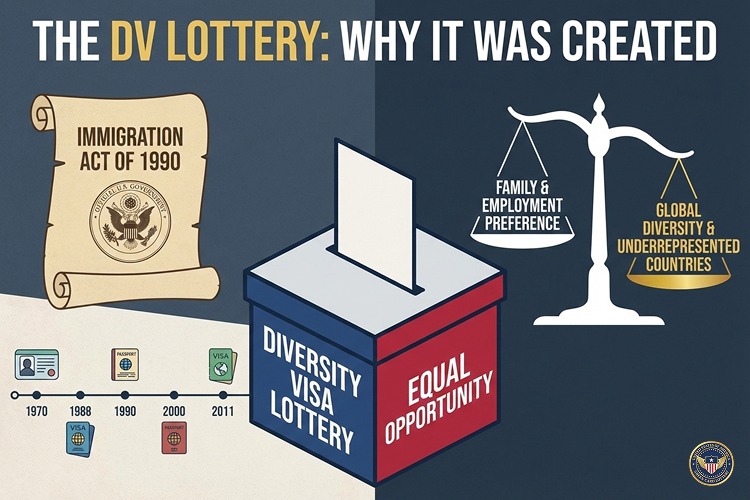
The DV Lottery was created under the Immigration Act of 1990. Before this law, U.S. immigration was heavily dominated by a small group of countries due to family-based and employment-based preferences.
Lawmakers recognized that this pattern reduced global diversity in U.S. immigration. As a solution, Congress introduced a lottery system that would allow people from underrepresented countries to immigrate legally.
The Core Purpose of the DV Lottery
1. Promoting Immigration Diversity
The primary goal of the DV Lottery is to diversify immigration by giving people from less-represented regions a fair chance to live in the U.S.
Countries that send large numbers of immigrants to the U.S. (such as India, China, Mexico, and the Philippines) are usually excluded, while countries from Africa, Europe, and parts of Asia are often included.
2. Equal Opportunity Immigration
Unlike skill-based or wealth-based visas, the DV Lottery provides an equal opportunity system. Selection is random and not influenced by:
- Income
- Education beyond basic requirements
- Social status
- Political connections
This makes the program especially attractive to applicants from developing nations.
3. Supporting Legal Immigration
The DV Lottery encourages legal, regulated immigration rather than undocumented pathways. Applicants go through:
- Security checks
- Medical examinations
- Background verification
This strengthens U.S. border control while maintaining humanitarian access.
How the DV Lottery Fits into U.S. Immigration Policy
The U.S. immigration system has three main pillars:
- Family-based immigration
- Employment-based immigration
- Diversity-based immigration
The DV Lottery is the only program dedicated entirely to diversity, which is why it continues to exist despite political pressure.
How Many People Benefit from the DV Lottery Each Year?
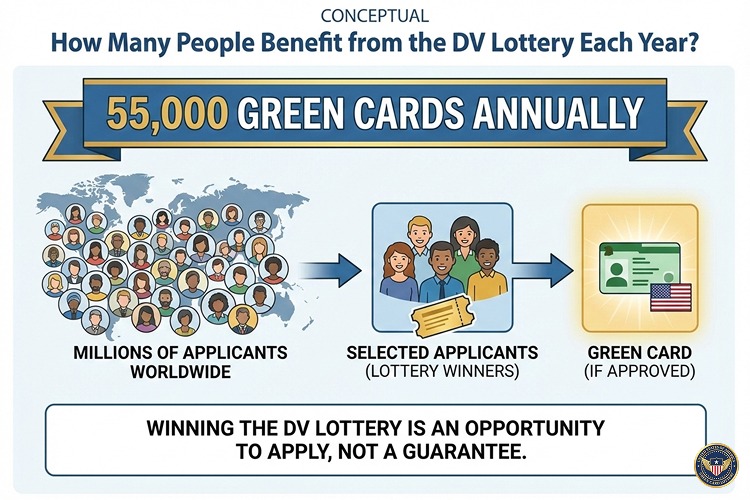
- Around 55,000 Green Cards are made available annually
- Millions apply worldwide
- More applicants are selected than visas available because not everyone qualifies or completes the process
Winning the DV Lottery does not guarantee a Green Card, it simply gives you the opportunity to apply.
Why Some Countries Are Not Eligible
Eligibility is based on immigration statistics, not politics or nationality bias.
If more than 50,000 immigrants from a country entered the U.S. over the past five years, that country is usually excluded for the next DV cycle.
This system ensures the program remains true to its diversity mission.
Is the DV Lottery Still Relevant Today?
Yes, perhaps more than ever.
Despite global mobility increasing, many people still lack access to employer-sponsored or family-based visas. The DV Lottery remains:
- One of the few immigration options without sponsorship
- A pathway for first-generation immigrants
- A bridge for global talent and cultural exchange
Political Debate Around the DV Lottery
Over the years, the DV Lottery has faced criticism:
- Some argue it should be merit-based
- Others say it poses security concerns
However, multiple government reports confirm that DV Lottery immigrants undergo the same screening as all other immigrants.
As of now, Congress continues to renew the program annually.
Why Many Applicants Seek Professional Guidance
Although the DV Lottery is free to enter, disqualification rates are high due to:
- Incorrect photos
- Missing family members
- Eligibility misunderstandings
- Duplicate entries
This is why many applicants choose professional assistance like US Green Card Office, which helps ensure applications meet technical and legal requirements and are submitted correctly throughout the year.
Does the DV Lottery Lead to U.S. Citizenship?
Yes. If selected and approved:
- You receive a Green Card
- You live and work permanently in the U.S.
- After five years, you may apply for U.S. citizenship (if eligible)
Common Misunderstandings About the DV Lottery
- It’s not a scam – it’s a lawful U.S. program
- No one can increase your chances – selection is random
- You must check results yourself – no emails are sent
- Being selected is not approval – further steps are required
Conclusion: Why the DV Lottery Still Matters
The DV Lottery exists to balance opportunity, fairness, and diversity within U.S. immigration. It remains one of the few programs where ordinary individuals, without wealth, sponsors, or connections, can legally pursue permanent residency in the United States.
Understanding the meaning and purpose of the DV Lottery helps applicants make informed decisions, avoid scams, and respect the rules of the program.