

The ongoing h1-b visa fee hike talks have become one of the most closely watched developments in U.S. immigration policy for 2026–2027. With rising political pressure, labor market shifts, and renewed scrutiny of foreign worker programs, potential changes to H-1B visa fees, requirements, and processing rules could significantly affect skilled professionals worldwide.
The H-1B visa program has long served as a gateway for highly skilled workers, particularly in technology, engineering, healthcare, and research, to work legally in the United States. However, discussions surrounding increased government fees, stricter enforcement, and policy realignment are raising concerns among employers and applicants alike.
This guide explains h1-b visa fee hike talks, how Donald Trump’s stance on H-1B visas continues to influence policy, and what applicants should realistically expect in 2026–2027.

What Is the H-1B Visa? (Meaning Explained Clearly)
The H-1B visa is a nonimmigrant work visa that allows U.S. employers to hire foreign workers in specialty occupations requiring theoretical or technical expertise. These roles typically demand at least a bachelor’s degree or equivalent experience.
When people ask “what is H-1B visa?” or “what is H-1B visas meaning?”, the answer is simple: it is a temporary work visa designed to fill skills gaps in the U.S. labor market while maintaining oversight and wage protections.
Key features of the H-1B visa program include:
- Employer sponsorship is mandatory
- A yearly numerical cap applies
- Wages must meet prevailing wage standards
- Initial validity up to three years, extendable to six
Why Are H1-B Visa Fee Hike Talks Happening Now?
The renewed h1-b visa fee hike talks stem from several converging factors affecting immigration policy in 2026–2027.
1. Administrative Cost Recovery
U.S. immigration agencies argue that processing costs have increased due to security checks, fraud detection, and compliance enforcement. Raising H-1B visa fees is being discussed as a way to offset these operational expenses.
2. Labor Market Protection
Policy makers claim that higher fees discourage misuse of H-1B visas by outsourcing firms and promote hiring of U.S. workers where possible.
3. Political Pressure & Public Debate
The topic of skilled immigration remains politically sensitive. Statements from leaders, including Donald Trump on H-1B visa policy, continue to influence public and legislative discourse.
Current and Proposed H-1B Visa Fees
Understanding H-1B visa fees is critical, especially as discussions around hikes intensify.
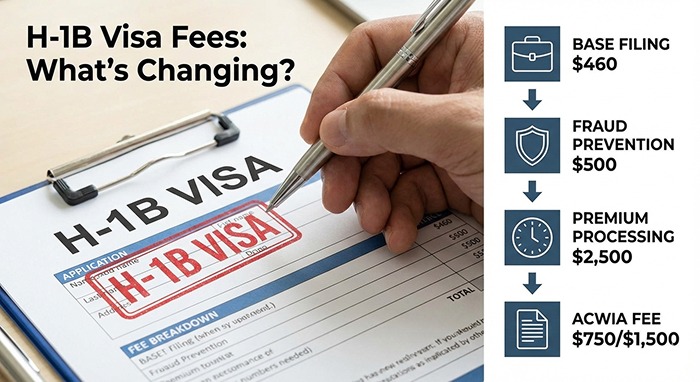
Existing Common Fees
- Registration fee
- Base filing fee
- Fraud prevention and detection fee
- ACWIA training fee
- Optional premium processing fee
These costs are paid mostly by employers, but higher fees can indirectly reduce job offers or sponsorship opportunities.
Possible Changes Under Discussion
- Increased base filing fees
- Higher fraud detection surcharges
- Tiered fees based on company size
- Reduced fee waivers for repeat sponsors
While not finalized, these proposals dominate current H-1B visa news for 2026–2027.
H-1B Visa Interview Waiver Changes (What to Expect)
One related area is H-1B visa interview waiver changes, which may tighten or loosen depending on policy direction.
In recent years, interview waivers helped speed up renewals. However, proposed reforms could:
- Limit waivers to low-risk applicants
- Require more in-person interviews for first-time applicants
- Increase scrutiny for change-of-employer cases
These changes aim to enhance vetting but may increase processing times.
Donald Trump on H-1B Visa Crackdown: Lasting Influence
Even outside office, Donald Trump on H-1B visa crackdown continues to shape immigration narratives.
During his presidency:
- Wage thresholds were emphasized
- Outsourcing firms faced stricter reviews
- Employer compliance audits increased
Many of the current H-1B visa new rules discussions reflect a continuation, or revival, of these principles. This includes fee hikes, stricter eligibility reviews, and closer monitoring of H-1B visa status compliance.
H-1B Visa Requirements (2026–2027 Outlook)
Despite ongoing policy talks, the core H-1B visa requirements remain largely intact.
Applicants must still demonstrate:
- A valid job offer in a specialty occupation
- Employer-sponsored petition
- Required academic qualifications
- Compliance with wage and labor rules
However, future changes may raise documentation standards and financial thresholds.
How Fee Hikes Could Affect Applicants and Employers
The impact of h1-b visa fee hike talks extends beyond paperwork.
For Employers
- Higher sponsorship costs
- Reduced willingness to hire entry-level foreign workers
- Greater compliance responsibilities
For Applicants
- Fewer sponsorship opportunities
- Increased competition
- Longer processing timelines
These realities make strategic planning essential.
H-1B Visa Program vs. Other Immigration Paths
Given uncertainty around H-1B visas, many skilled workers explore alternatives such as:
- Employment-based immigrant visas
- O-1 extraordinary ability visas
- Diversity-based immigration options
For individuals interested in permanent residency through random selection, professional guidance, such as from US Green Card Office, which specializes exclusively in Diversity Visa processing, can help applicants avoid costly errors unrelated to employment visas.
Future Outlook: Will Fees Increase in 2026–2027?
While no final decision has been announced, most immigration analysts expect some level of H-1B visa fee increase by 2027. The scale and structure remain uncertain, but preparation is key.
Applicants should:
- Monitor official announcements
- Avoid misinformation
- Understand timelines early
Final Thoughts
The h1-b visa fee hike talks reflect a broader shift toward stricter, cost-based immigration control rather than elimination of skilled worker programs. While uncertainty remains, informed preparation is the strongest advantage for both employers and applicants navigating the evolving H-1B visa landscape in 2026–2027.